Direct-fired vs indirect-fired heater: where the exhaust goes
- Written by
- Wade Holloway
- Checked
- Read
- 6 min
- Method
- How we write fixes
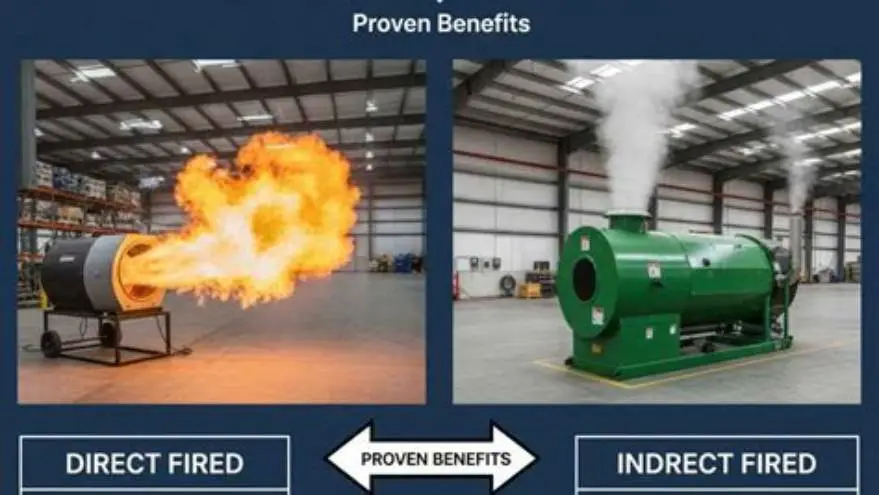
Direct-fired heaters release combustion gases into the air they heat. Indirect-fired heaters burn fuel inside a separated heat exchanger and send combustion gases through a flue. Many jobsite flameless units are indirect, but some catalytic propane heaters sold as flameless are direct-fired and must be used with ventilation. Trace the pipes before choosing one for a closed space.
Spec plate
- Direct-fired rating
- Often described as near 100% at the heater, before ventilation losses
- Indirect-fired rating
- Varies by model and load. Use the maker's spec sheet
- Parking heater exhaust
- Often about 1 in (22-25 mm), but measure your model
- Heated-air duct
- Often 2.4-3.5 in (60-90 mm), but measure your model
- Water from fuel
- Combustion produces water vapor. The amount depends on fuel chemistry
- Fuel use
- Read the maker's rate at the selected output
- Vans, tents, boats
- Use an indirect heater unless the maker specifically approves otherwise
Procedure index9 steps & sections
- Indirect fired heater vs direct fired: where the gases go
- Trace the pipes to find which type you own
- Spotting a torpedo-style unit
- Sort parking heaters and flameless units by their exhaust
- Read the efficiency rating for what it actually counts
- Give a direct-fired heater the air and monitoring it needs
- Match the heater type to the space you're heating
- Checklist
- Owners also ask
Indirect fired heater vs direct fired: where the gases go
Indirect fired heater vs direct fired comes down to one question. Where do the combustion gases go? In a direct-fired heater, the flame sits in the airstream. Combustion products mix with the air you're warming, including carbon monoxide, carbon dioxide and water vapor.
An indirect-fired heater keeps the flame inside a separated metal chamber called a heat exchanger. Room or cabin air passes over the chamber and picks up heat. Combustion gases travel through a flue instead of mixing with that heated air.
That split decides where each type can run. A direct-fired unit needs the steady air supply and exhaust exchange specified by its maker. A closed van, tent, shed or boat cabin often can't provide it.
Many jobsite flameless heaters use an indirect design. Some catalytic propane heaters also use the flameless label, yet remain direct-fired. Their combustion products enter the room, so the label never settles the question.
Trace the pipes to find which type you own
Do this with the heater cold and the power or fuel disconnected. You need a flashlight and about five minutes. Look for three separate paths: combustion gases, combustion air and heated room air.
- Find the flue connection. A diesel parking heater often has a narrow metal pipe and a muffler. A jobsite indirect unit usually has a round collar for stack pipe. No flue connection usually means direct-fired, but confirm with the data plate.
- Find the combustion-air intake. Parking heaters often have a second narrow pipe. A direct-fired unit commonly pulls combustion air from the room through its main fan.
- Find the heated-air path. Parking heaters use a separate duct for room air. That air passes around the heat exchanger, not through the flame.
- Follow the flue to its termination. It should discharge outdoors and stay clear of windows, doors, air intakes, fabric and stored fuel. Follow the maker's clearance instructions.
- Read the data plate and installation manual. Look for direct-fired, indirect-fired, sealed combustion or flue requirements. The wording varies by manufacturer.
Spotting a torpedo-style unit
Torpedo-style heaters are easy to spot. You'll see a cylinder with a fan at one end, an open front and no obvious stack. Most are direct-fired. If yours differs, stop and read the manual before running it.
Sort parking heaters and flameless units by their exhaust
VEVOR, Hcalory, Webasto and Espar sell diesel air heaters built around indirect combustion. The exact design still belongs to the model, so confirm the pipes and installation instructions. Combustion air enters through one route, while combustion gases leave through another.
Flameless needs care. On many jobsites, it describes an indirect diesel or kerosene heater with no visible flame at the outlet. Some catalytic propane heaters carry the same label while releasing combustion products into the room. Ignore the label and trace the combustion path.
Jobsite indirect-fired heaters add another wrinkle. Some draw combustion air from the room even though a stack carries gases away. A tightly closed building then needs make-up air. Use the maker's stated airflow or opening requirement for that model.
| Heater | Type | Combustion-gas path | Closed-space use |
|---|---|---|---|
| VEVOR or Hcalory diesel air heater | Usually indirect | Separate flue routed outdoors | Only after following the model's installation instructions |
| Webasto or Espar air heater | Usually indirect | Separate flue routed outdoors | Only after following the model's installation instructions |
| Jobsite indirect-fired unit | Indirect | Flue or stack connection | Depends on combustion-air and ventilation requirements |
| Torpedo or forced-air unit | Direct | Combustion products enter heated air | Open or ventilated areas only, as approved by the maker |
| Catalytic 'flameless' propane heater | Direct | Combustion products enter the room | Use only in the spaces and ventilation conditions listed by the maker |
Read the efficiency rating for what it actually counts
Direct-fired heaters are often described as near 100% efficient at the heater. Nearly all fuel energy becomes heat in the airstream. That figure does not count the heat lost when ventilation air leaves the space.
Indirect efficiency varies by model and load. Heat leaves with the flue gases, and the loss changes with burner setting, exchanger design, outdoor temperature and installation. Check the maker's spec sheet for its claimed figure, then treat it as a test-bench result rather than a promise for every installation.
Fuel-use figures need the same caution. Use the maker's stated consumption at the output you plan to run. Compare that figure with the heater's delivered heat output, not just its headline rating. If the documentation lists only fuel volume, measure the burn rate in your own setup with a known fuel amount and a timed run, following the maker's safety instructions.
Combustion produces water vapor. The exact amount depends on the fuel's chemistry and the amount burned. Diesel, kerosene, propane and other fuels do not produce identical amounts. Direct-fired heaters release that vapor into the heated space, while an indirect heater sends it through the flue with the other combustion gases.
That moisture matters in cold spaces. A direct-fired heater can fog windows and condense water on metal. An indirect heater keeps most combustion moisture out of the heated air, though people, cooking and wet gear still add moisture. Compare heaters using usable heat after the required ventilation, not just the number printed on the box.
Give a direct-fired heater the air and monitoring it needs
A direct-fired heater is one part of a system. The site must supply the rest, and the manual states the amounts. Treat these as requirements:
- Fresh air in: provide the opening area or airflow listed for the model and its output.
- Air exchange: provide the second opening or fan specified for stale air and moisture removal.
- CO monitoring: install and test the alarm type and placement required for the space. Never use an alarm as a substitute for ventilation.
- Fuel and clearance: use only the fuel on the data plate and keep the printed distance from combustibles.
- Placement: put the heater at the open end of the space, aimed across it and away from people.
Match the heater type to the space you're heating
Open-sided buildings, framed structures before they're closed in, large shops with doors open and outdoor work are where direct-fired units usually belong. Air exchange is constant. You accept that lost heat for fast, simple heating.
Vans, RVs, truck cabs, boats, tents, ice-fishing shelters, sheds and small garages need an indirect design unless the maker specifically approves another arrangement. Route the flue through the approved fitting and keep its termination clear of openings and air intakes. Follow the installation manual for every connection and clearance.
My call: pick indirect for any space you can't open to the outdoors. Choose direct-fired only for open work areas with the required air supply and monitoring. Run through this list first:
- Space: can you open it to the outside as the manual requires? If not, choose indirect.
- Sleeping: never use a direct-fired heater in a sleeping space. Follow the indirect heater's installation and alarm instructions.
- Fuel: use only the fuel printed on the data plate.
- Flue route: confirm the termination stays clear of air intakes, doors, windows and combustible materials.
- Make-up air: find the stated requirement for any model that burns room air.
Pick indirect for any space you can't open to the outdoors. Choose direct-fired only for open work areas that meet the maker's ventilation and monitoring requirements.
Checklist
- Trace the exhaust on a cold unit. A pipe or flue collar usually means indirect. No flue connection usually means direct-fired.
- Treat flameless as a marketing word until you've traced the combustion path.
- Indirect efficiency varies by model and load. Use the maker's spec sheet, and treat its figure as a test-bench result.
- A direct-fired setup needs the fresh-air opening and carbon monoxide monitoring specified for that model.
- Use one safety plan: follow the manual, keep combustion gases out of occupied air, and use a working CO alarm as directed.
Owners also ask
Can I add an exhaust pipe to a direct-fired heater?
No. A direct-fired unit has no separated combustion chamber or approved flue connection. Fitting a pipe does not convert its design. If you need combustion gases routed outdoors, buy an indirect unit.
Does an indirect heater still need fresh air?
A parking heater often draws combustion air through its own intake, so the flame does not need cabin air. People still need normal ventilation. Jobsite indirect units that draw combustion air from the room need the make-up air listed by the maker.
Why does my parking heater smell of fumes inside?
Suspect a leak, a damaged heat exchanger, or an intake positioned near the flue termination. Shut it down, leave the space, ventilate and check the setup only after it is safe. Use the CO safety rule in the ventilation section before the next run.
How much fresh air does a direct-fired heater need?
It depends on the output and model. The manual or data plate should give an opening area or airflow figure. If you can't find it, ask the maker rather than guessing.